I have chosen this as my focus film as there are several plot points that will help to back up both sides of my argument. There are many more female characters in this film than previous Marvel films and Black Widow particularly is shown to be very strong whilst in a battle situation, whilst still being extremely sexualised through her costume and being shown as 'weak' through both past trauma and an unneeded storyline. The film is on the borderline of passing and failing the Bechdel test, therefore causing a lot of controversy in the pop culture online communities.
Item 2: Supporting film - The Avengers (2012 dir. Joss Whedon)
I have chosen this film because once again Black Widow is presented as a strong woman, able to use her many talents in investigation and manipulation towards assisting The Avengers in their victory. However, once again her costume is very sexualised and the performances and subtext hint at a past relationship between herself and Clint Barton, which should not be necessary to the story line. Furthermore, apart from the occasional interjection from Agent Hill and Pepper Potts, Black Widow is the only female character in the main narrative, and is the only female Avenger. This film did not pass the Bechdel test, passing only 1 out of the 3 criteria, having more than two named female characters, however there are very few interactions between these characters, if at all.
Item 3: Supporting film - Captain America: The Winter Soldier (2014 dir. Joe and Anthony Russo)
My third film, much like the previous two, shows both sides of my argument through the character of Black Widow, once again showing her to be strong whilst still completely sexualising and romanticising her through her costume and actions. Whilst this film does include a few more female roles, they are mostly minor characters and are therefore not focused on by the film as much as the many male characters. As with The Avengers, this film did not pass the Bechdel test, as though there are multiple named female characters, who do converse with each other, they do not stray from the conversation topic of the male roles in the film.
Item 4: Book - Film as Social Practice (Third edition by Graeme Turner)
Chapter 5, Part 1 - Specifying The Audience
This explains that to bring in audiences, film makers and advertisers must make decisions to appeal to their target audiences. This is relevant to this project as it can give some insight into the reasons why Marvel present their female characters in certain, more sexualised ways, which I can link to the Male Gaze theory, so it is therefore a very useful source. This is therefore a very useful source to use in my argument.
Item 5: Book - The Film Theory Reader (Debates and Arguments edited by Marc Furstenau) (Theorists - Laura Mulvey and E. Ann Kaplan)
This book includes sections that explain what the male gaze theory is and discusses the reasons why writers and directors may present certain characters in order to manipulate or satisfy their male target audiences . I will use this for key quotes to back up my arguments, making it a very useful source.
Item 6: Book - Cultural Theory and Popular Culture: An Introduction (John Storey)
This book gives in depth definitions of Pop Culture and Ideology which will provide me with a basis to build my argument on as it provides the intellectual information on which I can build, linking it to my chosen films and the aspects of Pop Culture that Marvel is associated with.
Item 7: Interview - Joss Whedon for Rolling Stones magazine about The Avengers: Age Of Ultron
http://www.rollingstone.com/movies/features/secrets-of-avengers-age-of-ultron-joss-whedon-tells-all-20150422?page=5\
In this interview, Whedon discusses the romantic sub-plot between Bruce Banner and Natasha Romanoff (Black Widow) and whether or not it was needed. They also discuss how some of the scenes in the film affected not only Whedon, with him saying that Black Widow's flirtatious actions sometimes had even him seduced, but the majorly male audiences, which can be linked back to the male gaze.
Item 8: Interview - Scarlett Johansson on her Stunts and Costume
Item 7: Interview - Joss Whedon for Rolling Stones magazine about The Avengers: Age Of Ultron
http://www.rollingstone.com/movies/features/secrets-of-avengers-age-of-ultron-joss-whedon-tells-all-20150422?page=5\
In this interview, Whedon discusses the romantic sub-plot between Bruce Banner and Natasha Romanoff (Black Widow) and whether or not it was needed. They also discuss how some of the scenes in the film affected not only Whedon, with him saying that Black Widow's flirtatious actions sometimes had even him seduced, but the majorly male audiences, which can be linked back to the male gaze.
Item 8: Interview - Scarlett Johansson on her Stunts and Costume
http://www.babble.com/disney/captain-america-scarlett-johansson-on-the-black-widow-stunts-and-that-tight-costume/
Johansson discusses how she feels about the Black Widow costume herself and how she felt when doing her stunts. This source will be very useful in the other side of my argument, as she personally feels that it is, in fact, not overly sexualised. I can pick out some good quotes to argue that the costume is empowering rather than a pure sexualisation.
Item 9: Article - boringboring.net discussing a Scarlett Johansson interview
Item 9: Article - boringboring.net discussing a Scarlett Johansson interview
http://boingboing.net/2015/05/06/scarlett-johansson-maybe-hated.html
Though in general, this source is not particularly strong, it does include quite a few quotes that I can use in my argument about how Scarlett Johansson herself feels her character was treated in the film and whether the romantic sub-plot was needed for the film to be a complete piece of cinema.
Item 10: Article - A guide to the growing controversy over Joss Whedon’s Avengers and Marvel’s gender problem
Item 11: Article - Which Marvel Movies Pass The Bechdel Test
http://www.cipe.org/blog/2011/03/07/what-does-it-mean-to-empower-women/#.VikanTZdHIU
Item 14: Primary Research - Questionnaires of Film Students after watching focus film - The Avengers: Age of Ultron
Item 10: Article - A guide to the growing controversy over Joss Whedon’s Avengers and Marvel’s gender problem
http://www.vox.com/2015/5/11/8582081/avengers-age-of-ultron-joss-whedon
This article discusses how many people feel that Marvel have treated their female characters and the effect that this has had on their fan base. It is a very good source as it includes lots of points that will assist in building up my argument and I can quote many parts of it as evidence.Item 11: Article - Which Marvel Movies Pass The Bechdel Test
http://www.digitalspy.co.uk/movies/feature/a584511/which-marvel-movies-pass-the-bechdel-test.html#~prK6Gt5FLfStzu
This article discusses the fact that a distinct lack of Marvel's films pass the Bechdel test, something that only has three criteria points and should not be difficult to pass. A film should have two or more named female characters, these characters must have a conversation at some point in the film and, this conversation cannot be about a man. The article shows that my two chosen focus films do not pass this test in certain elements, and therefore cannot be seen as presenting women in an empowered light.
Item 12: Article - What does it mean to empower Women?
Item 12: Article - What does it mean to empower Women?
http://www.cipe.org/blog/2011/03/07/what-does-it-mean-to-empower-women/#.VikanTZdHIU
Item 13: Article - The Marvel Intertextual Universe
Media Magazine (Issue 54 December 2015)
This article is about the history of MCU films and how they link to each other making it mostly irrelevant to my topic, however I can use it for context about my chosen films, as well as being useful for quotes about the general target market for Marvel Cinematic Universe films.
Item 14: Primary Research - Questionnaires of Film Students after watching focus film - The Avengers: Age of Ultron
After reading the answers, I found some very interesting correlations between gender of the spectator and their opinions as to how the female characters in the film were presented. Most of the female students that were asked said that they felt female characters were presented badly, whereas male students did not see any particular problems with the female representation, which I can use as proof of the Male Gaze theory.
Item 15: Primary Research - Interviews with the target audience of MCU Films
Item 15: Primary Research - Interviews with the target audience of MCU Films
This research proved to be very interesting, as the target audience of superhero films is generally a very male dominated group. However, contrasting with the questionnaires of film students, almost all of the selected group of people, made up of male teenagers, agreed that Marvel does not present female characters enough in a way that empowers them and simply uses them to attract the male audience that otherwise would not be interested in a Superhero film.

Though this film does include a very strong Female character in the form of Peggy Carter, and could be used to back up the fact that Marvel do in fact give Female characters power, it is set in the 1930/40's and therefore does not give an effective view of women in modern society.
This interview swaps the questions that each actor would be expected to have and therefore comments on how Scarlett is treated by the media as an actor rather than how Natasha is treated by Marvel as a character.
Item 16: Picture - 'Captain America: The Winter Soldier' film poster
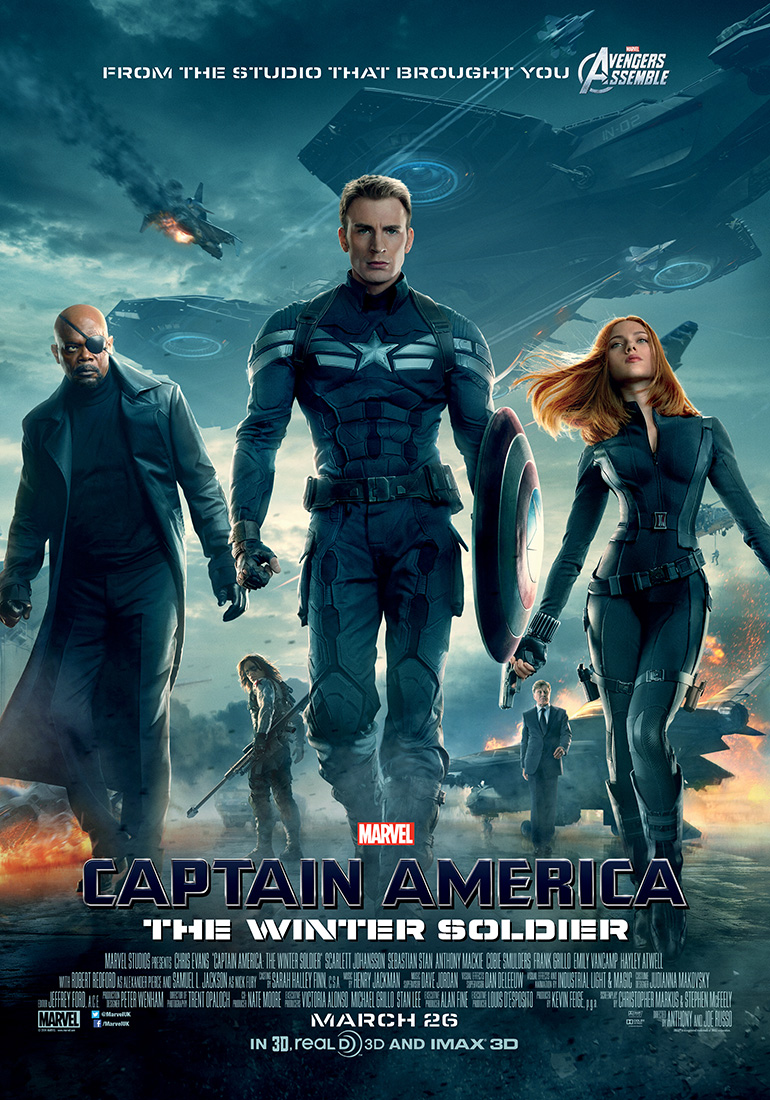
This is the film poster for my supporting film and it clearly displays the ways in which Black Widow is sexualised. She is the only female character shown on the poster and is pictured in her extremely sexualised, skin tight costume, behind two extremely empowered male characters. I will use this item as further visual evidence to back up how Black Widow is sexualised, not only in my focus films, but in the advertisement for them as well.
Rejected Items
Film - Captain America: The First Avenger
Though this film does include a very strong Female character in the form of Peggy Carter, and could be used to back up the fact that Marvel do in fact give Female characters power, it is set in the 1930/40's and therefore does not give an effective view of women in modern society.
Interview - Scarlett Johansson and Mark Ruffalo with Cosmopolitan
https://www.youtube.com/watch?t=371&v=T9sEkdJrIRMThis interview swaps the questions that each actor would be expected to have and therefore comments on how Scarlett is treated by the media as an actor rather than how Natasha is treated by Marvel as a character.
Article: Entertainment Weekly - The Black Widow Conundrum
http://www.ew.com/article/2015/04/29/entertainment-geekly-black-widow-conundrum
Though this article does discuss the treatment of Black Widow by the MCU franchise, it does not articulate it in a way that I could use to build an argument in the way that the vox.com article does, and would therefore make my work sound less developed. It focuses only on a single issue and does not present a particularly strong argument.Website: bechdeltest.com
This website has a large list of films, discussing whether or not they pass the Bechdel test, however they are decided by fans of the films and anyone may comment making changes, rather than being assessed by experts and film critics, meaning that it is not a very reliable source for my argument and I could easily find a critic assessed bechdel test for my chosen films.
